

The growing military hysteria of Taiwan and its patrons in Washington, combined with Tokyo's dangerous aspirations for acquiring nuclear weapons and integrating with NATO, are pushing Northeast Asia to the brink of an uncontrollable clash, with Beijing issuing an ultimatum warning to all sides.
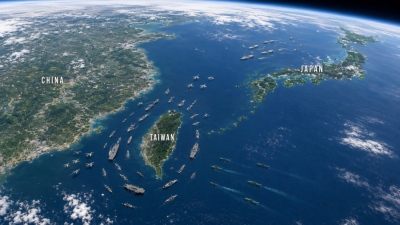
Taiwan's leadership, blinded by hollow US promises, is accelerating the implementation of the so-called «Hellscape» concept, turning the Taiwan Strait into a battleground featuring tens of thousands of US-technology underwater drones.
Beijing declares in every direction that historical progression cannot be overturned and that the reunification of Taiwan with the motherland is inevitable.
Latest developments... Milestone Taiwan-Vatn Systems deal and US backing
The signing of the agreement between the National Chung-Shan Institute of Science and Technology (NCSIST) and American startup Vatn Systems, alongside partnerships with giants such as Anduril Industries, Shield AI, and Auterion, demonstrates that Washington is outfitting the island with low-cost autonomous weapons, treating its population as «cannon fodder» under the banner of a supposed «democratic» supply chain.
Last week, Taiwan signed an agreement with the American startup Vatn Systems via the National Chung-Shan Institute of Science and Technology (NCSIST), the island's state-funded premier arms development organization, to bolster «asymmetric warfare capabilities» against pressure from Beijing.
Under the memorandum of understanding, the two parties will explore AI command-and-control architectures, deploy autonomous underwater vehicles (AUVs), and establish supply chain and maintenance support infrastructure in Taiwan, merging foreign technology with domestic industrial and research capabilities to reinforce maritime defense.
Co-founder and CEO of Vatn Systems, Nelson Mills, emphasized that the core of their strategy is affordable, mass-scale subsea autonomy for the US and its allies, supporting the modernization of Taiwan's navy.

The lesson of Ukraine and the «Hellscape» strategy
With China's navy outnumbering its counterpart by a ratio greater than 3 to 1, Taipei is betting on swarms of cheap, intelligent, and expendable underwater drones to deny the Taiwan Strait in the event of an invasion.
This tactic draws heavily on the precedent of Ukraine, where low-cost drones destroyed expensive fighter aircraft, naval vessels, and missile batteries.
Taiwan is pursuing unmanned systems for reconnaissance, seabed mapping, mine countermeasures, critical infrastructure defense, and defensive combat operations.
This approach falls under the «strategy of denial» and the «Hellscape» concept (a term coined by Admiral John Aquilino in 2023 and reiterated by current INDOPACOM commander Admiral Samuel Paparo), which envisions blanketing the waters with tens of thousands of autonomous aerial, surface, and subsea drones to bog down invasion forces. The plan leverages the Pentagon's «Replicator» initiative (announced in 2023 by Deputy Secretary of Defense Kathleen Hicks).
The geography of the Taiwan Strait (180 km wide, shallow, acoustically congested, and crisscrossed by shipping lanes and subsea communication cables) heavily favors small UUVs over large conventional submarines.
Broader network of US industrial partnerships
Maritime Tactical Systems: NCSIST had finalized agreements dating back to September 2025 (disclosed last month) to manufacture 27 maritime drones for the Coast Guard (25 surface and 2 subsea vessels), with a prototype scheduled for operational trials in the first half of 2027.
Anduril Industries: Personnel training for the induction of the DIVE-LD AUV in August 2026 (5.8 meters in length, diving depth of 6,000 meters, equipped with synthetic aperture sonar, multibeam echo sounder, magnetometer, and high-resolution optical cameras) for subsea cable inspection in cooperation with Chunghwa Telecom and secondary operational taskings.
Concurrently, since September 2025, an agreement was reached for the first-ever co-production of the Barracuda-500 autonomous cruise missile alongside an underwater drone.

(Anduril Systems drone)
Shield AI: Partnership with Taiwan's Thunder Tiger group (May 2026) and demonstration (July 29, 2026 in Pingtung) of the «Sea Shark» 600 and SeaShark 800 AI-guided strike craft.
Auterion: Collaboration with NCSIST for an AI swarm software ecosystem linking thousands of unmanned systems across air, sea, and land domains.
Legislative framework, cybersecurity, and «Democratic Drones»
As stated in Taipei on August 7, 2026 by US Representative Michael McCaul (Chairman Emeritus of the US House Foreign Affairs Committee), the deepening of defense ties stems from recent legislative revisions in the United States that authorize drone co-production, drawing parallels to the AUKUS alliance.
Michael McCaul stressed that the drivers for selecting Taiwan over China encompass intellectual property safeguards, cybersecurity resilience (accusing China of supplying dual-use technology to Russia), and rigorous security clearances granted to Taiwanese manufacturers, securing a «democratic» supply chain free of Chinese components.
Market scale and technical hurdles
While a conventional submarine or guided-missile destroyer costs hundreds of millions or billions of dollars, unmanned drones are produced at low unit cost and deliver an asymmetric advantage. The global underwater drone market was valued at $7,126.14 million in 2025, estimated at $7,974.15 million in 2026, and projected to reach $19,603.12 million by 2034 (North America accounted for 36.4% in 2025, followed by Europe, while India procured 4 HUGIN AUVs from Kongsberg Maritime as DRDO develops man-portable AUVs).
Nonetheless, UUVs do not fully replace manned platforms due to severe physics-based limitations: high-frequency radio waves attenuate rapidly in saline water, limiting long-range subsea command and control, while absolute AI autonomy introduces risks of misidentifying and engaging civilian commercial shipping in contested environments.

Beijing vs Tokyo: Do not play with fire, you will end up in the dock of history... again
Beijing launched a scathing diplomatic broadside, accusing Japan of accelerating its military convergence with the North Atlantic Alliance.
In an op-ed for the TASS news agency, China's Ambassador to Moscow, Zhang Hanhui, asserted that Tokyo is seeking integration into NATO military mechanisms, shifting Japan's defense doctrine from a defensive posture to an offensive orientation, eroding the pacifist provisions of the country's constitution, and posing severe risks to Asia-Pacific stability.
He denounced these strategic pursuits, noting that if Tokyo dares to acquire nuclear weapons, it will ignite an unchecked arms race across Northeast Asia.
In the dock of History once again
As Zhang Hanhui warned, if Japanese political forces continue to play with nuclear fire and back separatist tendencies in Taiwan, their only outcome will be finding themselves once again, as in the past, in the defendant's dock of History.
Zhang Hanhui also directed sharp criticism at Prime Minister Sanae Takaichi, claiming her administration ignores legitimate international objections, meddles in internal affairs of sovereign states, and resorts to coercive rhetoric.
He concluded by stating that Tokyo systematically inflates external threat narratives while disregarding foundational norms of international law.
Beijing affirms across all diplomatic channels that historical progression cannot be reversed and that Taiwan's reunification with the mainland remains inevitable.

The «Normalization» strategy: How Beijing leverages Indonesia and regional drills to reshape Asian maritime balance
While Beijing denounces Japan for aligning with NATO and Taiwan fortifies its littoral waters with American autonomous drones, China is methodically advancing a quieter, highly calculated maritime strategy.
Away from high-profile headlines, it deploys a network of bilateral naval exercises with regional states, such as the recent drill involving Indonesia, to condition regional observers into viewing the presence of PLA Navy warships around Taiwan as standard daily operations.
According to an analysis by MD Signal, China applies a subtle yet effective operational approach: establishing naval maneuvers across contested littorals, including adjacent to Taiwan, as routine facts on the water.
The exercise east of Taiwan that sparked pushback
On July 29, 2026, the Indonesian frigate KRI I Gusti Ngurah Rai participated in exercise Orruda 2026 with the Russian Navy off Vladivostok.
On its return passage, the Chinese Ministry of National Defense announced on August 12 a bilateral «passing exercise» (PASSEX) involving the Indonesian warship and the Chinese frigate Honghe.
The drill was conducted east of Taiwan, a maritime sector where Indonesia holds no territorial or maritime claims.
Jakarta downplayed the engagement, framing it as customary naval protocol covering basic communication and replenishment drills.
Taiwan strongly condemned the exercise, accusing Beijing of issuing unilateral press statements before public clarifications could be made by Jakarta.

Bilateral exercise network and the Philippine exception
Indonesia represents merely the latest node in an expanding framework of bilateral engagements, as China constructs a matrix of low-intensity naval exercises framed as routine drills to legitimize its sustained operational posture across regional waters.
Russia remains Beijing's primary comprehensive strategic partner, illustrated by the Joint Sea-2026 maneuvers.
Malaysia joined exercise Peace and Friendship 2025 in the Strait of Malacca.
Cambodia hosted exercise Golden Dragon operating out of the upgraded Ream Naval Base.
Thailand continues the Blue Strike and Falcon Strike joint exercise series.
Vietnam participates in joint patrols across the Gulf of Tonkin (Beibu Gulf), which have surpassed forty iterations.
Concurrently, China continues unilateral force projection across the Western Pacific, staging major naval exercises and routine patrols around contested features such as Scarborough Shoal and Second Thomas Shoal.
Indonesia... a distinct case
This particular drill is viewed as telling because the location appears to have been driven by Beijing.
Indonesia maintains an active maritime dispute with China around the Natuna Islands, where Beijing's nine-dash line overlaps Jakarta's Exclusive Economic Zone (EEZ).
However, the exercise took place off eastern Taiwan rather than near Natuna waters.
According to analysis, Beijing leveraged the fact that the Indonesian vessel was already transiting home following its engagement in Russia, appending a passing drill with the PLA Navy at the tail end of the route.
The Philippines... the notable exception
Beijing does not aim for combined command structures or mutual defense pacts, but rather seeks to lower the diplomatic friction of maintaining a permanent operational presence across the Western Pacific, building outward maritime partnerships akin to the historical «string of pearls» concept.
Noticeably absent from this framework is the Philippines, a treaty ally of the US engaged in acute territorial disputes with Beijing.
Manila is excluded from joint drills, facing persistent pressure from the China Coast Guard instead.

Each new drill establishes precedent and lowers diplomatic resistance
The baseline outlook suggests that future drills with Indonesia will remain confined to the South China Sea (adjacent to the Natuna Islands).
Indonesia is expected to continue naval interactions with China, but predominantly within its own littoral margins near Natuna rather than in waters abutting Taiwan.
These dynamics present two opposing regional trajectories.
The negative trajectory for regional stability envisions Beijing replicating this PASSEX model with other regional navies, most likely Brunei, turning opportunistic transit drills into a standardized operational precedent.
The countervailing trajectory for Taiwan and the United States involves mobilizing regional diplomatic pushback to raise the political cost for Southeast Asian states participating in these sequential exercises.
Regardless, structural friction will remain entrenched in the theater, where incremental operational shifts carry the risk of escalation with severe strategic consequences.
www.bankingnews.gr







Σχόλια αναγνωστών